
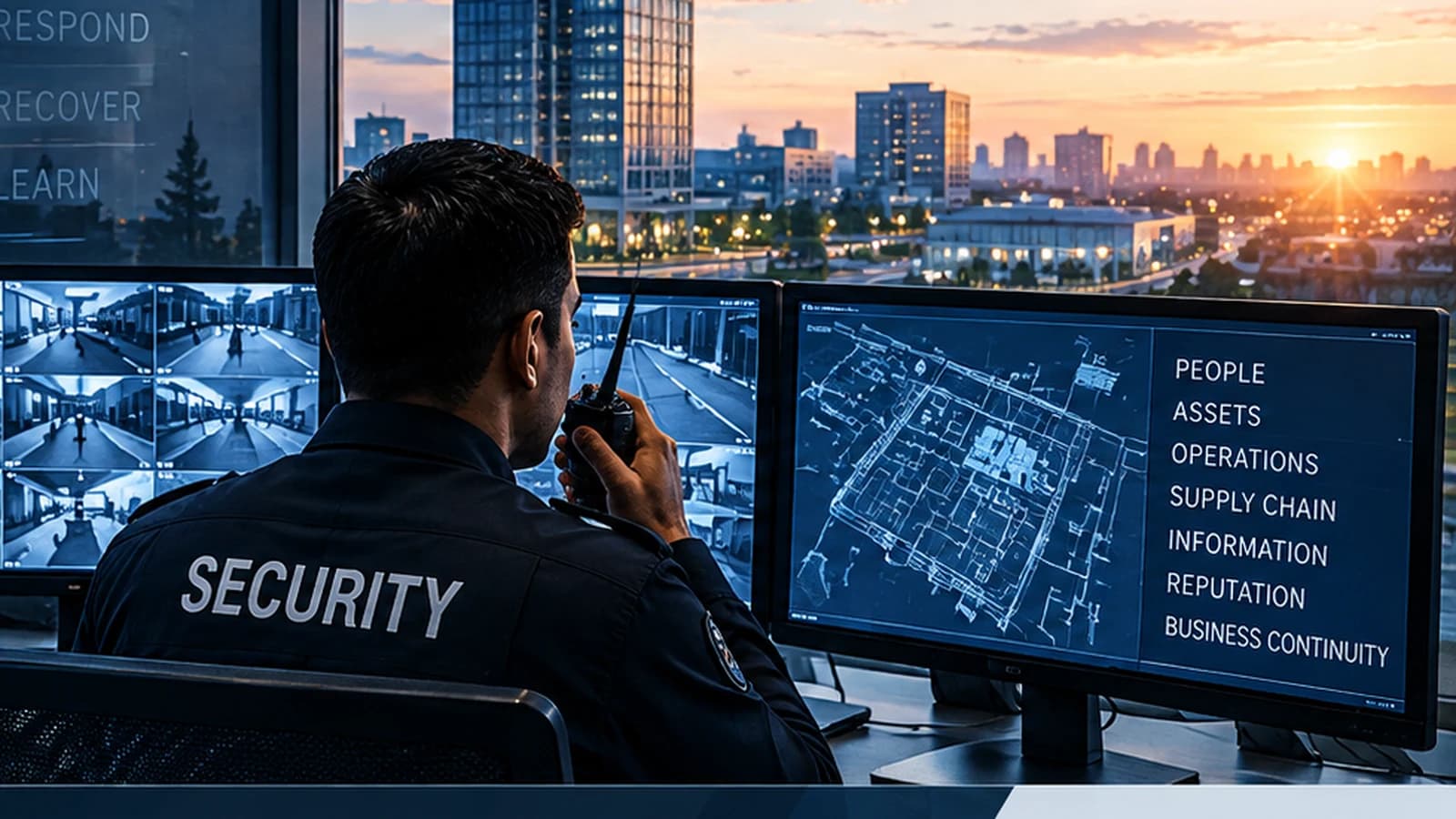
"The question is no longer whether an organization has security systems. The real question is whether those systems, people and processes can work together when something actually goes wrong."
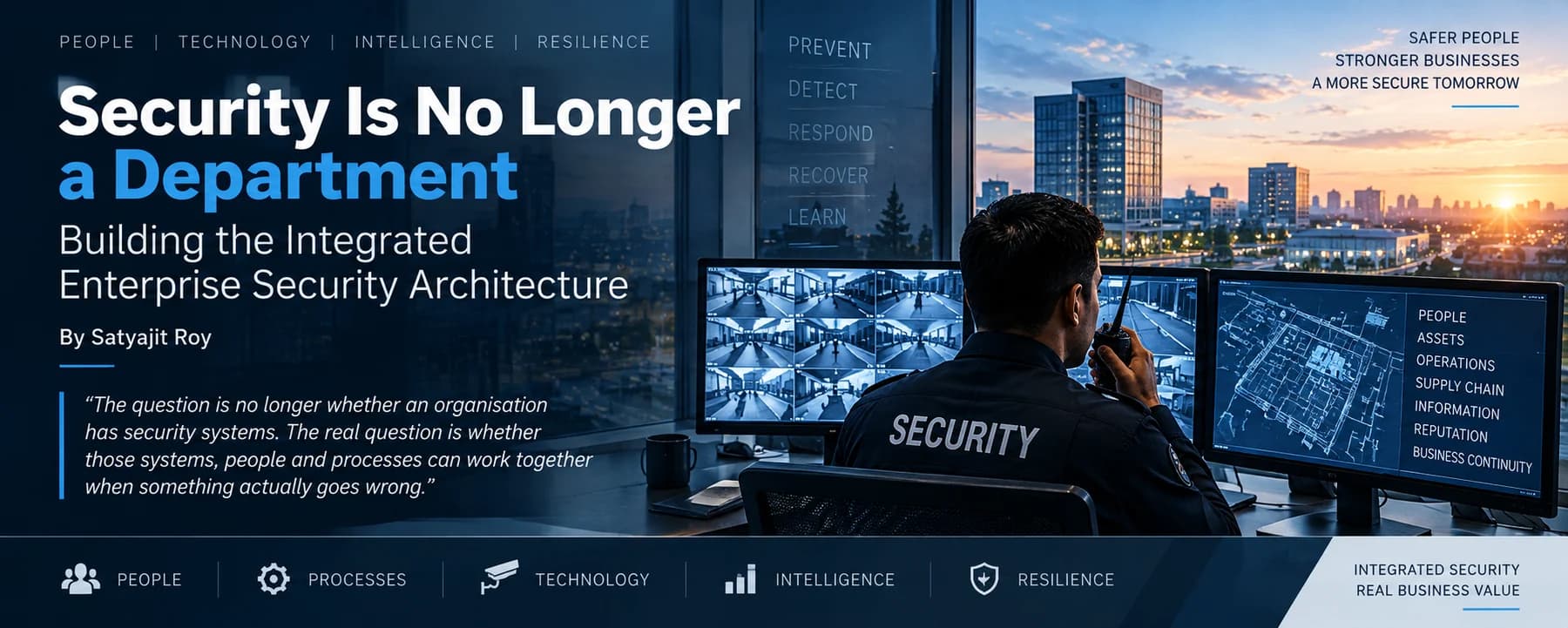
For decades, enterprise security was largely understood through a familiar collection of measures: security personnel at the gates, CCTV cameras on the walls, access-control systems at entry points and alarms protecting critical areas. Those measures remain important. But they are no longer sufficient.
The modern enterprise operates in an environment where physical, digital and operational risks increasingly intersect. A security incident can affect employees, production, intellectual property, supply chains, data, and reputation and business continuity—often simultaneously. This is forcing a fundamental change in how security should be designed and managed.
Security can no longer operate as a collection of disconnected functions. It must operate as an integrated enterprise capability.
That means bringing together people, technology, procedures, intelligence and leadership around a common understanding of risk.
From Security Equipment to Security Architecture
One of the most persistent weaknesses in enterprise security is the tendency to buy equipment before defining the problem. A new CCTV system is purchased because the existing cameras are old. More guards are deployed after an incident. Access control is upgraded because cards or readers have become obsolete. The result can be a collection of individually capable systems that do not necessarily create a capable security environment.
The starting point should instead be risk.
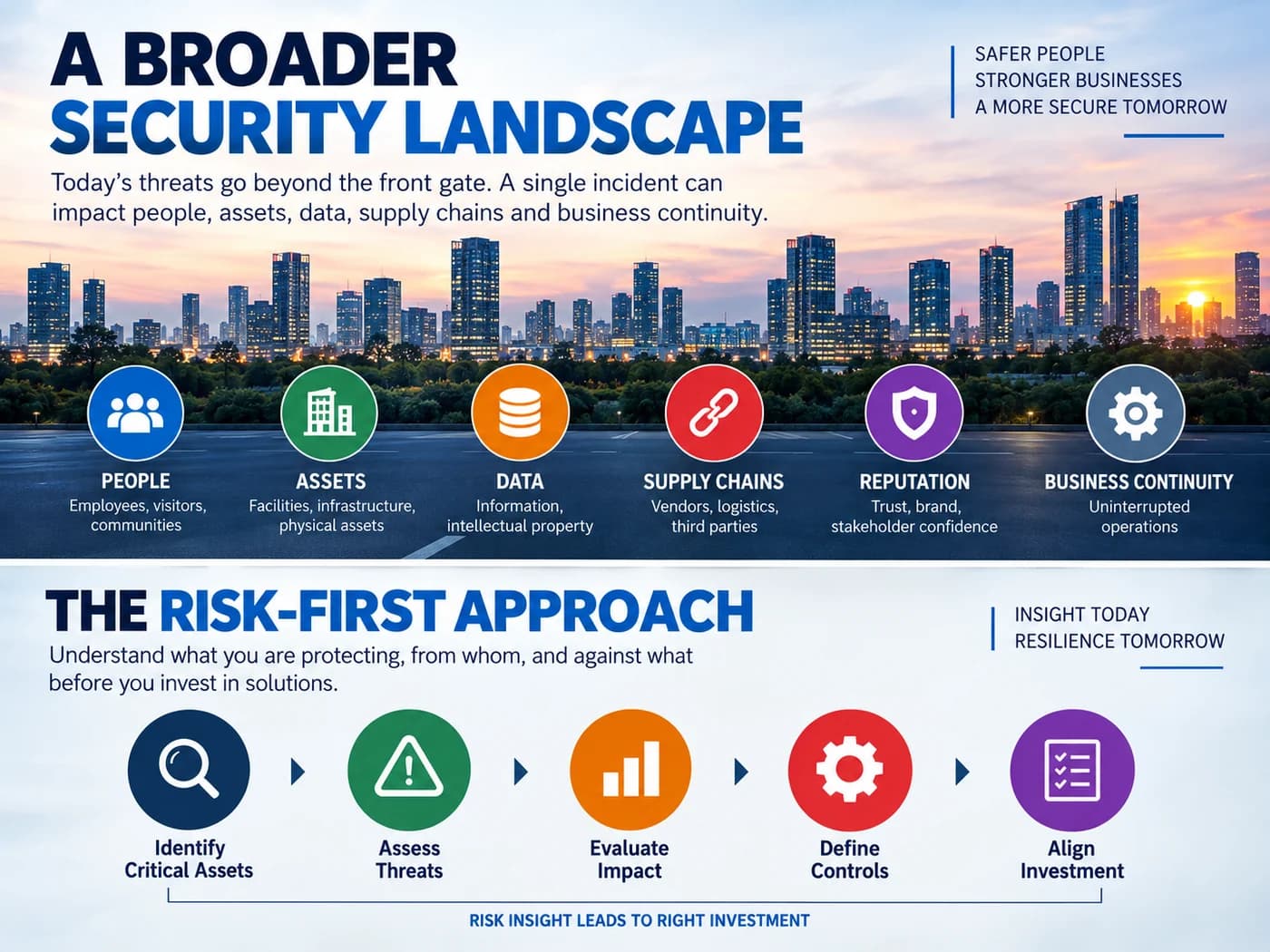
What are the organization's critical assets? Where are its vulnerabilities? What threats are credible? What would be the operational and financial consequences of a successful attack, intrusion, theft, disruption or safety incident? Only after these questions have been answered should the organization determine the appropriate combination of manpower, technology, procedures and investment.
This risk-first approach is increasingly important as organizations seek to demonstrate that security investment is proportionate to actual business exposure. Security magazine has similarly highlighted the importance of assessing threats and potential losses before determining the appropriate technology investment.
Integration Is the Force Multiplier
The real value of security technology emerges when individual systems begin to work as one.
Consider a perimeter intrusion alert.
In a fragmented environment, an alarm may appear on one system, while the operator separately searches multiple camera screens and perhaps checks access-control records. In an integrated environment, the same event can trigger the relevant camera, identify the location, display associated access information and guide the operator through a predefined response.
The difference is not simply technological. It is situational awareness.
Integration reduces the cognitive burden on operators and allows them to concentrate on events that actually require human intervention. Security magazine has previously noted that combining access control, intrusion detection, perimeter protection and video can improve operator performance while reducing screen fatigue. The objective, therefore, should not be "more cameras" or "more alarms".
It should be better information leading to better decisions.
The Human Element Still Matters
Technology does not eliminate the need for people.
In fact, as security systems become more sophisticated, the quality of the people operating and managing those systems becomes even more important. Security personnel remain the first point of contact for employees, contractors and visitors. They identify unusual behavior, manage access, respond to incidents and often become the organization's first responders during emergencies.
But the future security officer cannot be defined simply by headcount.
The emphasis must shift towards competence, deployment, supervision, training, communication and response capability. Technology should extend human capability—not create an illusion that human judgment is no longer required.
AI: From Watching to Understanding
Artificial intelligence may represent the next major transformation in physical security.
Traditional video surveillance largely asks humans to watch. AI-enabled systems increasingly allow organizations to ask machines to identify, classify and prioritize. This can include detecting predefined behaviors, unusual activity, perimeter breaches, vehicle movements, objects or other events that warrant attention.
The significance of AI is therefore not that it replaces the security operator. Its greatest value may be that it helps the operator determine where to look and what deserves attention. As I have observed, advances in AI and vision technologies are opening the possibility of converting what cameras observe into actionable information at a scale that humans alone cannot achieve.
But organizations should resist the temptation to adopt AI simply because it is fashionable. Poorly configured analytics, excessive false alarms, inadequate data governance and overdependence on automation can create new risks.
AI should be deployed against defined security outcomes—not as an end in itself.
The Physical-Cyber Divide Is Disappearing
Perhaps the most important change is that physical security and cyber security can no longer be treated as completely separate disciplines.
Modern cameras, access-control systems, sensors, servers and command centers are connected systems. They generate data, communicate over networks and increasingly interact with enterprise IT infrastructure. A compromised security device can therefore become an enterprise cyber risk. Conversely, a cyber incident can have direct physical consequences.
Security teams must consequently work much more closely with IT, facilities, operations, HR, legal and business leadership.
This is not about creating another layer of bureaucracy. It is about recognizing that the organization has one risk environment, even if it has multiple security functions.
I have similarly described the convergence of physical and cyber security as a critical consideration for organizations seeking an integrated approach to protecting people, assets and information.
From Incident Response to Organizational Resilience
A mature security program should not be judged only by how many incidents it prevents. It should also be judged by how effectively the organization responds when prevention fails.
Resilient security architecture should support the complete incident lifecycle:
Prevent → Detect → Assess → Respond → Recover → Learn
The final step is often neglected. Every significant incident should produce institutional learning.
- What happened?
- Why did it happen?
- How quickly was it detected?
- Did the technology work?
- Did people know what to do?
- Was the escalation process effective?
- Could the same event happen again?
Security becomes considerably stronger when these lessons are systematically converted into revised procedures, improved training, better technology and changed risk priorities.
Security Must Demonstrate Business Value
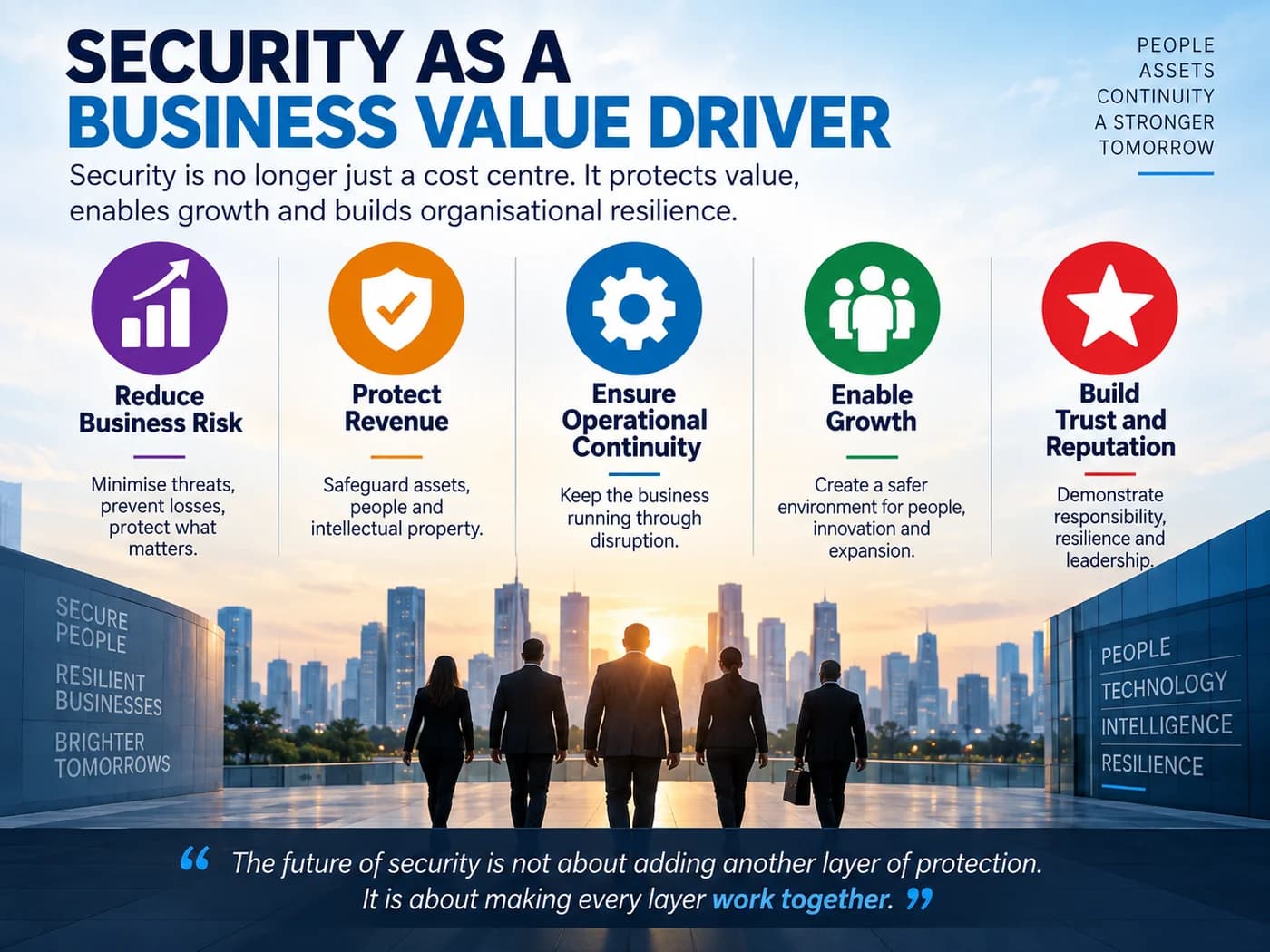
The final transformation is perhaps the most important one. Security leaders must increasingly move beyond reporting the number of guards deployed, cameras installed or incidents recorded.
The C-suite needs to understand security in terms of business risk, resilience and continuity.
- What critical business risk is being reduced?
- What losses are being avoided?
- How quickly can the organization recover?
- Which vulnerabilities remain?
- Is the investment proportionate to the risk?
This is consistent with the broader evolution of physical security from a traditional cost center toward a business value driver, with greater collaboration between security, IT, finance and organizational leadership.
The strongest security leaders will therefore not simply ask, "How much does security cost?" They will ask, "What is the cost of not being secure?"
The Next Generation of Security
The future of enterprise security will not be defined by a single technology. It will be defined by integration.
- People supported by technology.
- Technology guided by intelligence.
- Processes designed around risk.
- Information converted into decisions.
- And security aligned with the organization's broader objectives.
The organizations that perform best will not necessarily be those with the largest security budgets or the greatest number of devices.
They will be those that understand their risks most clearly—and build integrated security architecture capable of preventing, detecting, responding to and learning from those risks.
"The future of security is not about adding another layer of protection. It is about making every layer work together."
Security is no longer simply a department responsible for protecting the enterprise. It is becoming part of the architecture through which the enterprise remains resilient.
About the author
Commander Satyajit Roy (Retd.)
CISM | CSP | CSM
Security & Risk Management Professional | Head – ManTech & Total Integrated Security Solutions, CISS Services Limited
Commander Satyajit Roy (Retd.) is a veteran Indian Navy aviation specialist and an accomplished security and risk-management professional, currently serving as Head – ManTech & Total Integrated Security Solutions at CISS Services Limited. With a distinguished career spanning National Security, Homeland Security, security operations, risk and crisis management, asset protection and integrated security, he brings extensive multidisciplinary experience to the private-security and enterprise-security domain.
A holder of numerous professional certifications and licenses across security, business continuity, risk management, cyber security and related disciplines, Commander Roy is also a recognized keynote speaker and panelist, regularly contributing to leading security networks, industry forums and professional conferences. He is a prolific writer, researcher and thought leader on emerging dimensions of security, technology and national resilience, and has been featured in interviews and discussions across leading media and professional platforms.
His work is characterized by a strong emphasis on integrated security, technology-enabled risk management, loss prevention and the convergence of physical, cyber and operational security.